FPSC Curriculum Expert
"Explore the complete FPSC Secondary School Teacher SST BS-17 syllabus 2026 for FGEI schools, including test pattern, Professional Education topics, English syllabus, educational psychology, teaching methods, assessment, research, and preparation strategy. Focus Keyphrase: FPSC SST BS-17 Syllabus 2026"
FPSC Secondary School Teacher SST BS-17 Syllabus 2026 for FGEI Schools
The FPSC Secondary School Teacher SST BS-17 examination is an important recruitment test for candidates seeking permanent teaching positions in Federal Government Educational Institutions. These posts are generally associated with FGEI Cantts and Garrisons schools under the Ministry of Defence and are filled through the Federal Public Service Commission. Candidates who plan to appear in this examination should first understand the official syllabus, paper pattern, and major professional areas. The test is designed to assess both basic English competence and professional knowledge related to education, teaching, psychology, assessment, administration, and research. A focused preparation strategy is therefore more useful than studying random general knowledge material.
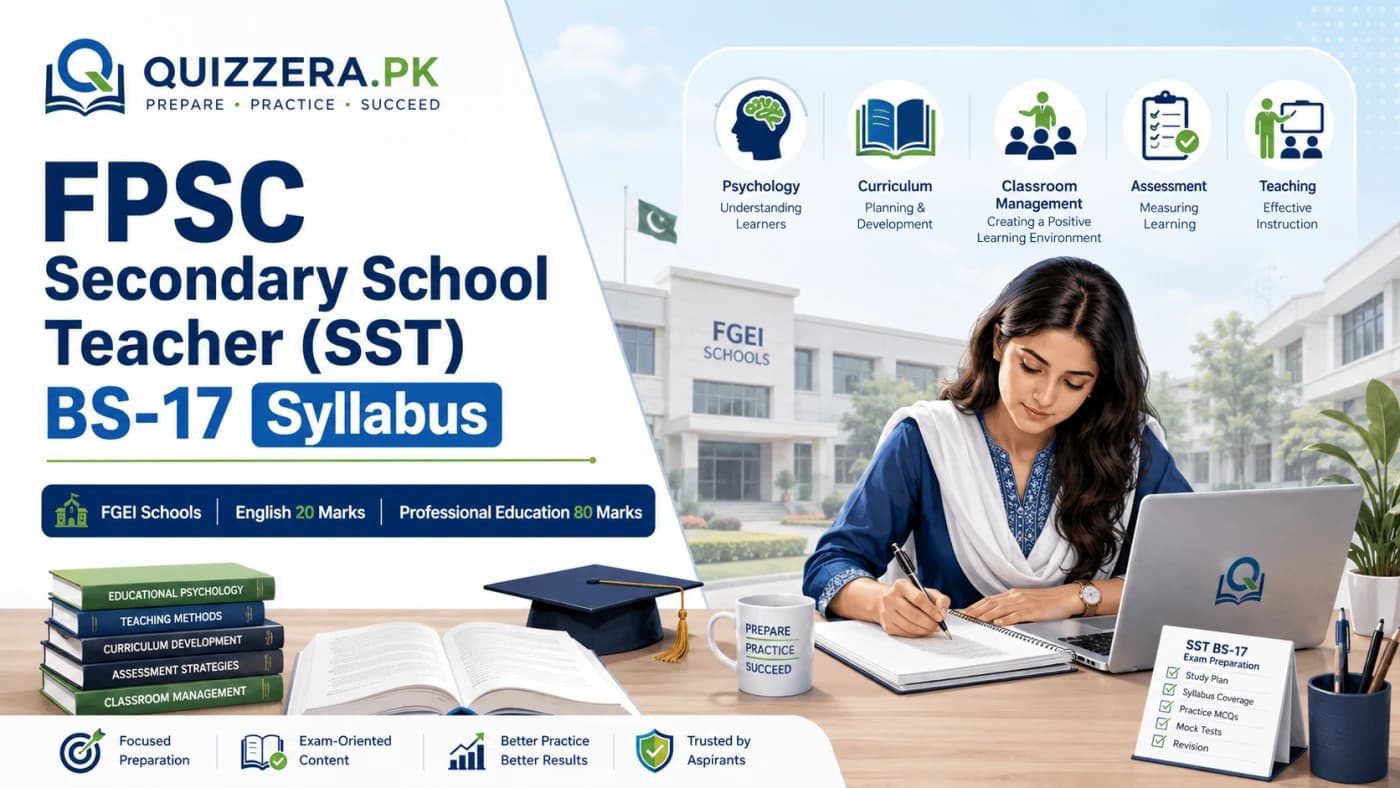
For recent SST recruitment patterns, the FPSC written test has been structured as a 100-mark objective paper consisting mainly of English and Professional Education. English generally carries 20 marks, while the professional portion carries 80 marks, making education-related topics the most important part of the examination. Candidates should therefore dedicate the majority of their preparation time to teaching concepts rather than relying only on grammar or general awareness. The professional section evaluates whether a candidate understands how students learn, how classrooms should be managed, how curriculum is designed, and how student performance is assessed. This makes the SST examination different from many general FPSC screening tests.
FPSC SST BS-17 Test Pattern
The most important starting point is the test structure because it helps candidates divide their study time intelligently. The commonly used pattern for FGEI SST recruitment consists of Part I: English for 20 marks and Part II: Professional Education for 80 marks. The examination is objective in nature, which means candidates must prepare concepts in a way that allows them to identify the correct option quickly. Professional Education carries four times more marks than English, so it should receive proportionately greater attention. However, candidates should not ignore English because those 20 marks can significantly affect the final merit position.
Part IEnglish20Part IIProfessional Education80Total
100
Part I: English – 20 Marks
The English section mainly tests vocabulary, grammar usage, and sentence structuring, which are standard areas in competitive examinations. Candidates should prepare synonyms, antonyms, one-word substitutions, commonly confused words, contextual vocabulary, and correct word usage. Grammar preparation should include tenses, articles, prepositions, pronouns, conjunctions, subject-verb agreement, active and passive voice, and direct and indirect narration. Sentence correction, sentence completion, error identification, and correct word order are also important for improving accuracy. Regular MCQ practice can make this section highly scoring because English questions often follow recognizable patterns.
Candidates should avoid preparing English only through memorization because FPSC questions may test application rather than simple recall. For example, a question may ask candidates to identify the grammatically correct sentence rather than directly asking for a rule. Vocabulary questions may also test the meaning of a word in a particular context instead of asking for a direct synonym. Reading standard English material and solving previous competitive examination MCQs can therefore improve both speed and understanding. Candidates should revise common grammar rules repeatedly during the final weeks before the examination. A strong English foundation can help secure marks that are often lost through avoidable mistakes.
Part II: Professional Education – 80 Marks
Professional Education is the core of the FPSC SST BS-17 syllabus, and candidates should prepare it comprehensively. Major areas include Perspectives of Education in Pakistan, School Administration and Supervision, Planning and Management in Education, Educational Psychology, Curriculum Development and Assessment, Teaching Methodology, and Classroom Management. Educational Measurement and Evaluation, Research Techniques in Education, Educational System in Pakistan, and Educational Guidance and Counselling are also important. These areas collectively test the professional competence expected from a secondary school teacher. Candidates should focus on understanding concepts, theories, definitions, differences, applications, and the contributions of major educationists.
Perspectives of Education in Pakistan
Perspectives of Education in Pakistan covers the philosophical, social, historical, and national foundations of education. Candidates should understand the meaning, scope, and objectives of education along with its role in individual and national development. The Islamic concept of education, moral development, citizenship, social responsibility, and character building are also important areas. Students should study major educational challenges in Pakistan, including literacy, access, quality, gender disparity, educational inequality, and the public-private divide. Knowledge of major education policies and reforms is also useful because such questions frequently appear in teacher recruitment tests.
This section should not be treated as simple history because the examination may test the relationship between education and national development. Candidates should understand how education contributes to economic growth, social mobility, human capital, national integration, and democratic citizenship. They should also recognize contemporary issues such as digital learning, teacher quality, curriculum reform, school dropout, and unequal access to education. Understanding the structure of Pakistan's education sector can help candidates answer both conceptual and policy-oriented questions. Comparative understanding is especially useful when distinguishing between formal, informal, and non-formal education.
School Administration and Supervision
School Administration and Supervision focuses on how educational institutions are organized, led, monitored, and improved. Candidates should study the responsibilities of principals, head teachers, administrators, supervisors, and teaching staff within a school system. Important concepts include educational leadership, school organization, staff management, school records, communication, discipline, teacher supervision, and institutional planning. The difference between administration, management, inspection, and supervision should be clearly understood because these terms are often confused in MCQs. Questions may also test different leadership styles and their suitability in educational settings.
Educational supervision is particularly important because it directly influences teaching quality and professional development. Candidates should learn about instructional supervision, clinical supervision, democratic supervision, classroom observation, teacher evaluation, and feedback mechanisms. The objective of supervision is not simply to identify mistakes but to improve teaching practices and student learning outcomes. Modern supervision emphasizes cooperation, professional support, mentoring, and continuous improvement rather than authoritarian inspection. Candidates should therefore understand both traditional and contemporary approaches to educational supervision.
Planning and Management in Education
Planning and Management in Education deals with how educational goals are transformed into practical institutional actions. Important topics include strategic planning, operational planning, institutional development, decision-making, leadership, resource allocation, staff management, monitoring, and evaluation. Candidates should understand the basic functions of management such as planning, organizing, staffing, directing, coordinating, reporting, and budgeting. Educational planning also requires identifying needs, setting objectives, allocating resources, implementing activities, and reviewing outcomes. Questions may test both theoretical management principles and their application in schools.
Effective educational management is closely linked with leadership, motivation, teamwork, and communication. A good school manager must coordinate teachers, students, parents, administrative staff, and available resources to achieve institutional objectives. Candidates should know different leadership styles such as democratic, autocratic, transformational, and laissez-faire leadership. They should also understand the importance of school development plans, performance monitoring, and evidence-based decision-making. Proper management improves both administrative efficiency and academic performance.
Educational Psychology
Educational Psychology is one of the highest-priority areas in the FPSC SST examination because it explains how students learn and develop. Candidates should prepare the major theories of Jean Piaget, Lev Vygotsky, B. F. Skinner, Ivan Pavlov, Edward Thorndike, Albert Bandura, Jerome Bruner, Abraham Maslow, and Benjamin Bloom. Piaget's stages of cognitive development, Vygotsky's Zone of Proximal Development, Skinner's operant conditioning, and Pavlov's classical conditioning are particularly important. Thorndike's laws of learning and Bandura's social learning theory should also be revised carefully. Questions often test the name of a theorist together with a specific educational concept.
Candidates should also study intelligence, motivation, memory, attention, perception, personality, individual differences, learning difficulties, and child development. Maslow's hierarchy of needs is important for understanding student motivation, while reinforcement theories explain how behaviour can be strengthened or reduced. Educational psychology helps teachers select appropriate methods according to learners' age, readiness, interests, and cognitive development. Candidates should focus on practical classroom applications of psychological theories instead of memorizing names alone. Understanding examples makes it easier to answer application-based MCQs.
Curriculum Development and Assessment
Curriculum Development covers the planning, design, implementation, and evaluation of educational experiences. Candidates should understand the difference between curriculum and syllabus as well as formal, informal, hidden, core, and activity-based curricula. Major curriculum models such as the Tyler Model, Taba Model, and Wheeler Model should be studied along with their key characteristics. Learning objectives, content selection, teaching strategies, assessment methods, and curriculum evaluation are central components of this section. Questions may test the sequence of curriculum development or ask which model is associated with a particular theorist.
Assessment should also be linked with curriculum outcomes because modern education emphasizes alignment between objectives, teaching, and evaluation. Candidates should understand how assessment helps determine whether intended learning outcomes have been achieved. Formative assessment supports learning during instruction, while summative assessment usually evaluates achievement after a unit or course. Diagnostic assessment identifies learning difficulties, while placement assessment helps determine a learner's appropriate level. These distinctions are frequently tested in professional education examinations.
Teaching Methodology and Classroom Management
Teaching Methodology covers the strategies teachers use to facilitate learning effectively. Important approaches include lecture, discussion, demonstration, project-based learning, problem-solving, inquiry-based learning, cooperative learning, collaborative learning, activity-based learning, discovery learning, and experiential learning. Candidates should also understand student-centred teaching, differentiated instruction, inclusive education, and the effective use of teaching aids. Lesson planning is another important area, including learning objectives, prior knowledge, introduction, presentation, practice, assessment, closure, and homework. Modern teaching focuses increasingly on active participation, critical thinking, creativity, collaboration, and problem-solving.
Classroom Management focuses on creating an environment in which learning can take place efficiently and respectfully. Candidates should study classroom rules, discipline, student motivation, teacher-student relationships, conflict resolution, positive reinforcement, behaviour management, time management, and seating arrangements. Effective classroom management emphasizes prevention of behavioural problems rather than excessive punishment. Teachers should establish clear expectations, maintain consistency, encourage participation, and respond fairly to disruptive behaviour. A well-managed classroom supports both academic achievement and students' emotional well-being.
Educational Measurement and Evaluation
Educational Measurement and Evaluation is another important scoring area because it includes both theoretical and practical concepts. Candidates should know the differences among measurement, assessment, testing, and evaluation. They should prepare formative, summative, diagnostic, and placement assessment as well as achievement, aptitude, intelligence, and standardized tests. Characteristics of a good test include validity, reliability, objectivity, practicality, and usability, and these concepts are frequently asked in MCQs. Candidates should particularly understand that validity concerns whether a test measures what it is intended to measure, while reliability concerns consistency.
Basic educational statistics should also be reviewed, including mean, median, mode, range, percentage, and standard deviation. Candidates may encounter questions related to item analysis, difficulty level, discrimination index, grading, and test construction. The structure of an MCQ should also be understood, including the stem, correct option, and distractors. Teachers use assessment data not only for grading but also for improving instruction and identifying learner needs. Therefore, candidates should understand assessment as part of the teaching-learning cycle.
Research Techniques in Education
Research Techniques in Education introduces candidates to the methods used to investigate educational problems systematically. Important concepts include research problems, objectives, research questions, hypotheses, variables, population, samples, and sampling methods. Candidates should differentiate among quantitative, qualitative, mixed-method, experimental, descriptive, survey, case-study, and action research. Data collection methods such as questionnaires, interviews, observations, tests, and document analysis should also be prepared. Questions often test definitions, purposes, and differences between research methods.
Sampling is another important topic because researchers rarely study an entire population. Candidates should understand random sampling, stratified sampling, systematic sampling, cluster sampling, convenience sampling, and purposive sampling. They should also know the difference between primary and secondary data, along with basic concepts of validity, reliability, and research ethics. Action research is especially relevant to teachers because it allows educators to investigate and improve problems in their own classrooms. A practical understanding of educational research can make this section easier to master.
Educational System in Pakistan and Guidance Counselling
Candidates should understand the overall structure of Pakistan's education system from early childhood and primary education to secondary, higher secondary, technical, vocational, and university education. Important institutions include the Ministry of Federal Education and Professional Training, Higher Education Commission, provincial education departments, examination boards, and curriculum-related authorities. Public education, private education, madrassa education, distance learning, online learning, and teacher education should also be reviewed. Candidates should be familiar with major educational reforms and persistent challenges affecting access and quality. This section connects educational policy with the practical functioning of institutions.
Guidance and Counselling focuses on helping learners make educational, personal, social, and career-related decisions. Candidates should differentiate between guidance and counselling and understand educational, vocational, personal, and career guidance. The counselling process generally involves establishing rapport, identifying problems, gathering information, exploring options, assisting decision-making, and conducting follow-up. Important qualities of a counsellor include empathy, confidentiality, patience, respect, active listening, and objectivity. Teachers often act as the first source of guidance for students, making this topic highly relevant to SST candidates.
Important Theorists for FPSC SST
ThinkerJean PiagetCognitive DevelopmentLev VygotskyZone of Proximal DevelopmentB. F. SkinnerOperant ConditioningIvan PavlovClassical ConditioningEdward ThorndikeLaws of LearningAlbert BanduraSocial Learning TheoryBenjamin BloomBloom's TaxonomyAbraham MaslowHierarchy of NeedsJerome BrunerDiscovery LearningJohn DeweyLearning by DoingBloom's Taxonomy for SST Preparation
Bloom's Taxonomy is an essential topic because teachers use it to plan objectives, activities, and assessments. The revised cognitive taxonomy contains six levels: Remember, Understand, Apply, Analyze, Evaluate, and Create. Lower levels generally focus on recalling and understanding information, while higher levels involve interpretation, problem-solving, evaluation, and creativity. Candidates should know the verbs associated with each level because examination questions may ask which learning objective belongs to a particular cognitive category. Bloom's Taxonomy is also closely connected with lesson planning, curriculum development, and assessment design.
How to Prepare for FPSC SST BS-17
Candidates should divide preparation according to the weight of each section instead of studying all topics equally. Educational Psychology, Teaching Methodology, Curriculum Development, Measurement and Evaluation, Administration, and Research Methods deserve considerable attention. English should be practised daily through grammar exercises and vocabulary MCQs rather than being left for the final days. A candidate should also solve topic-wise MCQs after completing each subject because active recall strengthens memory more effectively than repeated reading. Weekly mock tests can help identify weak areas and improve time management.
A practical 30-day strategy can begin with Educational Psychology during the first five days, followed by Teaching Methodology and Classroom Management. Curriculum Development and Bloom's Taxonomy can be covered during the next few days, followed by Measurement and Evaluation. Administration, supervision, research methods, guidance, and Pakistan's education system can then be studied systematically. The final week should focus on revision, English practice, high-frequency concepts, and full-length mock examinations. Candidates should also review their incorrect MCQs because mistakes often reveal the concepts that need the most attention.
Prepare FPSC SST MCQs with QUIZZERA.PK
QUIZZERA.PK can support FPSC SST candidates through structured, topic-based MCQ practice rather than unorganized preparation. Candidates can focus separately on Educational Psychology, Teaching Methodology, Curriculum Development, Assessment, Classroom Management, Research Methodology, Educational Administration, Guidance and Counselling, and English. Regular practice can improve accuracy, recall, confidence, and examination speed while helping learners identify areas that require additional revision. Mock examinations can also simulate the pressure of the actual screening test and improve time management. The best preparation combines conceptual study with continuous MCQ practice.
Final Words
The FPSC Secondary School Teacher SST BS-17 examination for FGEI schools requires strong professional knowledge rather than simple rote memorization. Candidates should understand how learners develop, how teachers teach, how curricula are designed, how classrooms are managed, and how learning is assessed. Educational Psychology and teaching methodology should be studied conceptually, while research, administration, counselling, and education-system topics should be reinforced through MCQs. Regular revision and mock testing are essential because objective examinations reward both knowledge and speed. Candidates preparing consistently with structured resources on QUIZZERA.PK can build a more focused and examination-oriented preparation strategy.
Academic Sources & References
FAQs
What is the FPSC SST BS-17 test pattern?
The commonly used FGEI SST test pattern consists of 100 marks, with 20 marks for English and 80 marks for Professional Education.
Is FPSC SST BS-17 a permanent post?
Yes, when the official FPSC advertisement lists the vacancy as permanent, the appointment is made against a permanent federal government post subject to applicable service rules.
Which organization recruits SST BS-17 teachers?
FPSC recruits Secondary School Teachers for Federal Government Educational Institutions, including FGEI Cantts and Garrisons schools under the Ministry of Defence.
What is the most important section of the FPSC SST test?
Professional Education is the most important section because it carries 80 marks out of 100.
How many marks are allocated to English in the FPSC SST test?
English carries 20 marks and generally includes vocabulary, grammar usage, and sentence structuring.
What topics are included in Professional Education?
Major areas include Educational Psychology, Teaching Methodology, Curriculum Development, Classroom Management, Educational Measurement and Evaluation, Administration, Research Techniques, Guidance and Counselling, and the Education System of Pakistan.
Is Educational Psychology important for FPSC SST preparation?
Yes, Educational Psychology is a major preparation area and candidates should study learning theories, motivation, intelligence, memory, development, and individual differences.
Is Bloom’s Taxonomy important for the SST exam?
Yes, Bloom’s Taxonomy is highly relevant to teaching objectives, lesson planning, curriculum development, and educational assessment.
Are Piaget and Vygotsky important for FPSC SST?
Yes, candidates should understand Piaget’s cognitive development theory and Vygotsky’s social constructivist concepts, including the Zone of Proximal Development.
Is General Knowledge included in the FPSC SST syllabus?
In the syllabus pattern discussed for recent FGEI SST recruitment, there is no separate General Knowledge section unless a specific FPSC advertisement states otherwise.
Is Current Affairs included in the FPSC SST test?
Current Affairs is not listed as a separate section in the referenced SST syllabus, but candidates should always verify their specific FPSC case number.
Is the FPSC SST exam subject-specific?
Recent FGEI SST syllabus patterns have focused mainly on English and Professional Education rather than a separate specialist subject paper.
What is the best way to prepare for FPSC SST BS-17?
Candidates should study each professional education topic conceptually, practice topic-wise MCQs, revise regularly, and attempt full mock tests.
How should candidates divide their preparation time?
Most preparation time should be given to Professional Education, while English grammar and vocabulary should be practiced consistently every day.
Where can candidates practice FPSC SST MCQs?
Candidates can use QUIZZERA.PK for topic-wise MCQ practice, mock tests, and focused preparation for Professional Education and English.
Editorial & Verification Guarantee
Every piece of advice in this article aligns strictly with the official exam syllabus.
Transform Insight into Action
Don't just read about it. Practice immediately using QUIZZERA's adaptive AI MCQ repository customized for Study Tips.